
If you don’t know what it is, read this entry on Poe’s Law. Or this Wired piece.
Poe’s law isn’t new. But it’s something that in the current climate of “The President’s Tweets are official Whitehouse Communications,” we might have to re-think it for the current generation.
Poe’s Law posits that on the internet, without using emoticons or disclaimers, it is impossible to create satire that won’t be taken as truth by some users.
It’s true. If you don’t believe it, take a look at how often people think stories on the Onion are true. World leaders have made this mistake.
This goes back much deeper into human communicative history than Poe’s Law (circa 2005). This is a problem that has existed since humans first tried to utilize satire. The dilemma is simple: we all know how to laugh, and we all know what we think is “funny.” But funny– and particularly the circa 2017 internet version of funny, deeply sarcastic and often mean spirited– is far more subjective than any other pathos-based appeal.
Don’t believe me? Just watch!
Let’s say you want people to save animals. You show them poor, abused former pets and play Sarah Mclachlan. As you are pulled from the wreckage, most people feel at least a little sullen for the poor puppers and kittehs.
Even if you’re pro choice (I am, big time) you get that feeling in the pit of your stomach when someone says “Baby killer!”
And, of course, you all feel that same seething, Red Lantern level of rage when you see that smug douche Tom Brady, right?
Most emotions we can at least assume that if the appeal doesn’t land, it’s hard to mistake. No one is going to start happily chanting “kill the babies” or “abuse those kittens.” Even a person not sympathetic to the cause can understand the message. It’s… easy to get.
But what about this joke?

Not my creation. Also, I don’t think it’s funny. Although the sucker itself… is kind of funny.
But here’s a situation where the underlying mechanism that I think power Poe’s Law is at play. To a certain demographic, this is funny. To some, it’s laugh-out-loud funny. To others, it’s more of a tongue-in-cheek “I see what you did there” chuckle at the nature of the Twilight novels and movies.
But it’s also homophobic, and to some people it’s downright hurtful.
Here’s another. A famous meme.
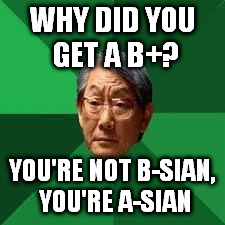
I’ve been called on the carpet for using this meme (Asian Dad) in presentations before, but trust me, I worked with (and studied under) LuMing Mao. I know an Asian stereotype being used for humor when I see it. It’s racist. It’s not funny. At least not to me. No doubt it’s racist. But this is one of those racist stereotypes that permeates popular culture. There’s whole ten minute segments of some stand-up routines about this (Dat Phan, Margaret Cho, Dr. Ken, etc.).
Is it funny? To some people, it is. To some Asians it is. To others… it’s super hurtful. Just like grouping a whole continent of people into being “Asians” is hurtful and limiting.
This illustrates the issue at hand, though. It’s hard enough to determine intent online, but when you deal with intent that could be funny or could be spewing hatred, there is almost literally no way to know how such things should be taken. Someone will be hurt. And part of the reason for that is, as you can see if you read this article about Richard Pryor or if you’ve ever seen Chris Rock, Dave Chapelle, Kumail Nanjiani or Aziz Ansari perform, that comedy works best when it’s pushing on those racist and sexist and homophobic assumptions that guide the dominant culture. It’s funny when Chris Rock talks about car dancing and singing along to Gwen Stefani’s Hollaback Girl because no one likes that song (not even Gwen’s “lover” Blake Shelton). It’s a song you’d expect one of the Mean Girls to bump in their ride. Rock knows we expect him to be listening to Jay-Z or 2pac. And such assumptions are about race and how race is inscribed.
The difference in Chris Rock then being able to make a joke about how racist a white friend is by whether or not he sings the n words in a Dr. Dre song as it plays on the radio and me making a joke using that same n word are miles apart. And I’m not even white.
A final dangerous element in all of this– sort of the ghost pepper spice at the end of the whole concoction– is that cruelty is so radically becoming normalized again in America (after years of attempts to make things better socially) that Poe’s Law is also now a thin defense. Make a comment online that is taken wrong? “Oh– I was joking!”
We took a torch to accountability and burned it to ashes next to where we used to have respect and consideration.
So hey, everyone, piss off! I hate you all. 🙂
But there’s a smiley face, so you know I’m joking.
Fuckers.