
Long before I was completely sure what rhetoric was, I was studying it. I’ve had a keen interest in political science, religion, sociology, etc. since I was in junior high school. As such, I sometimes infuse some of the lesser-used voices from one field into another and pull out weird comparisons and contrasts. That’s my way of saying this post might seem a little weird, but if you follow along, I hope it will be interesting.
President Trump has made me return to an old debate in my head: St. Augustine vs. Thomas Aquinas.
Now anyone who is astute realizes this wasn’t a literal fight. The two men lived a little over 800 years apart in different parts of the world. But their ideas, separated as they are by the years and the changes in society (in their actual societies) represent two sides of a coin.
I’m going to be reductive. If you’re super interested, you can read more here on Augustine and here on Aquinas. The two men had numerous thoughts that one could explore for far longer than a career, but what I am referring to here, with our fine President, is the debate about the nature of the human being at birth.
St. Augustine believed in the doctrine of original sin. Basically speaking, he believed we are born with the predisposition to do evil, to behave in selfish and destructive ways, and that it is only through living a life of faith and grace that one can approach “good.”
Aquinas, though he agreed with Augustine on many other points, believed the opposite. He believed that humans are born as a tabula rasa, pure of heart and “good,” and that living in the world slowly corrupts a person away from that state of grace.
So for one, life was an attempt to make good from bad. For the other, life was an attempt to stave off corruption.
I have always been on the Aquinas side of the debate. This, of course, is based on my own desire for people to be inherently good. As a person who believes in observation and critical thinking, there’s no evidence that people start good. There’s not really any evidence that people start bad, either, but I’m starting to think there’s a trend that might illustrate that many humans, at default level, are selfish and through their selfishness might be “evil,” or closer to evil on the sliding scale.
Where might I get that idea, you might ask?
Our current President and his supporters.
Now given, none of them are infants. I hope we didn’t let any infants vote or hold office, anyway. But I think the natural state of at least some of the people who support our President, and sadly at times his own default stance, is one of evil. There’s no logical reason for the level of hate being shown to people who are different (be that color, gender, sexual orientation, etc.). Trump fucking won, if no one noticed. The selfish rich 1-percenters won handily this time around. There’s no need for them to run over people in the streets or to protect their racist statues. Theirs is a hatred without benefit, a malice that burns their energy and simply looks ugly. They’re not gaining supporters; they have those supporters. They’re just scaring innocent people who don’t have a horse in the race. It’s… sad.
But it made me think, of all things, of one of my favorite comic books, Rob Schrab’s Scud: The Disposable Assassin (if you’ve ever watched me stream, I have an autographed copy of one of my favorite issues of this comic on the wall right behind my desk). I always felt Scud was po-mo at its finest, but I’m starting to think it might have been even more brilliant than I thought it was. I think it might be the metaphor for what we’re becoming.
So here’s the deal, to again greatly reduce: Scud is about a robot assassin, as the title might have clued you to. In the world of Scud, there are vending machines that a person can walk up to, make a deposit of money, then name a target for the robot inside to go kill. The robot would then self-destruct. Seems like a post-modern thing, right? Take the human out of contract killing, blow up the evidence, everyone’s happy.
Scud, however, happens upon a mirror while he’s hunting down his target (which is a strange decidedly non-human creature named Jeff). In the mirror, he sees his own back and reads the warning label:
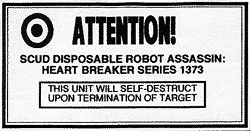
Once Scud realizes that if he kills his target he will die, he begins to concoct a plan. He puts Jeff on life support. This preserves Scud’s life. But, of course, keeping a mutant creature on life support costs money, so Scud has to go out and make a living. And he was– like Bender from Futurama– made for one thing, in this case, killing.
So Scud becomes a contract killer to stay alive.
Now given, Scud is fictional, and he’s not a human being. But the story makes me wonder about whether or not maybe we are stuck in a world where we are assumed to do evil and hence must compromise to get where we want to be. Scud didn’t want to kill– he was made for killing. But he had to keep killing in order to live.
Augustine, I guess you win this one. With yellow awesome robots, anyway.