
I tend to use pop culture elements in my blog posts. Today, I want to use a former gimmick from now WWE wrestling superstar Bobby Roode. When he was in another promotion, he wore this t-shirt frequently:
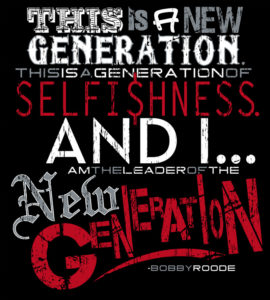
At the time I thought it was brilliant as a gimmick for him, and I noted (as most of you probably did) how it echoes what older people say about millennials. They’re always staring into their devices, taking pictures of themselves and their meals. They’re always selfishly buying, coveting, consuming, etc.
But it also made me think about a discussion I had with a mentor not all that long ago. When my book hits (coming #soon), you’ll be able to read that part of what I was attempting to do with my research was establish what an Indigenous storyteller’s methodology would be. One of the things this did was foreground me as part of the research. I’m the narrator, in a storytelling sense as well as in the obvious sense of it being research. I appear in the data, which is mostly presented in the form of narrative chunks.
Someone once said “this isn’t research data. You’re just talking about what you saw and did.”
My response to that– pardon me if I’m blunt– is to ask what exactly data is if it’s not what you see and do. The data in my research is complex and situated, it’s based on kairos and familiarity. It requires being fleshed out to be understood.
I also had a mentor, the one I was talking to, raise a strange objection to a different piece I was working on. I wrote a teacher’s-tool sort of hypertext document about memes, and as part of it, I made example memes that appeared on each page. There’s a specific, and important, reason why I did that; it’s modeling, but it’s also to maintain the coherence of the document. The examples flow logically from the text around them because in most cases I made them (and the last part of the piece explains how I made them so others can do the same). I was told this was “self-indulgent” and that it isn’t proper scholarship. I was told that we shouldn’t interject ourselves into our work, that we’re not meant to be a part of it.
I protested that a bit, but as the not-even-actually-junior-faculty in a conversation with a mentor, I took the advice and filed it away.
But the truth of the matter is that the experts in the discipline where I came from– people I trained with in some cases– tell their own stories as a part of their scholarship. People like Gail Hawisher and Cindy Selfe, Jim Porter (who is my colleague now, and had life gone a little differently would have chaired my dissertation), Bonnie Nardi, James Paul Gee, Malea Powell… they have all written pieces that foreground their presence in what they’re talking about.
In my case, it’s actually a step deeper, as I’m not an arrogant or self-aggrandizing person. Truth be told, I’d rather blend in and listen to learn. But I am trying to build a methodology that doesn’t cast my cultural understanding into the waste basket, one that uses the storytelling and meaning making of my ancestors. I have to be present in my work.
But what bothers me more is that looking back, I think I missed the context of that conversation. I don’t think the assertion was ever that a scholar cannot talk about herself in her research, or that a scholar shouldn’t: I think the implication was that certain people can and certain people — like me— can’t.
And I think the reason for that bias is the same reasoning that made the Bobby Roode gimmick I mentioned at the start here work. To older, more established, scholars, a “young guy” is from the arrogant, selfish generation ( I guess I was sort of young at the time; I’m 40 now, hardly a young guy. Some of my associate professor colleagues are younger than me). In the eyes of the person making this criticism, I don’t think it was believed that I had earned it or that I was worth it. I don’t know if I wasn’t old enough or wasn’t white enough, or if it was because I was willing to question the ideas of people who many scholars valorize.
I’ve never written anything academically to insult another scholar. I don’t do the things that I do out of disrespect. And the last thing I would ever mean to do is disrespect the scholars I named above (I’ve taken courses from Cindy, Gail and Malea, fanboy regularly after Gee and Nardi, and I work with Porter, who I think is absolutely amazing). I am just pointing out that no one told them it was unacceptable to write about their experiences for academic audiences (or if they were told not to, they weren’t actually gate-kept away from doing it anyway). If someone had, there wouldn’t be a discipline of Computers and Writing at all.
So here’s my whole argument about this: there aren’t many Native Americans in academia. Of the ones who are, many have chosen– for whatever their reasons may be– to take on the methods and traditions of the existing academy, sometimes preaching a “know their way better than they do” methodology. I respect that, but I don’t think it moves the needle. I think it allows for a different kind of colonization, a willing subjugation. It might be the smarter fight, the better way to persist in the academy (I seem to remember hiding in a big wooden horse working once), but it’s not what I came here to do. Maybe I’m more reckless because I come from a poor family and wasn’t ever supposed to make it this far. Maybe I feel like I’m playing with the house’s money now.
Another argument I have frequently with other scholars is that we shouldn’t expect scholars from under-represented groups to speak for the entire group. And, for the record, I don’t claim that my way of doing Indigenous, that my trying to utilize Storyteller methods, is the voice of everyone who is Indigenous. How could it be? I will claim, until my last breath, that any white scholar who tries to tell me I don’t do Indigenous scholarship correctly can kiss every square millimeter of my ass, though. That’s one of the few rights you don’t get as a white person in America. You don’t get to tell this specific Cherokee how to be Cherokee. You lost that right when you tried to erase my family and my ancestors had to hide from your death march west. No, you get to let me have my space to try to do my thing, and you might have to either bite your tongue or at the very least respect that I have a differing opinion that is valid. You won’t use me to silence younger scholars like me. I’m no one’s punching bag. I’ve watched you do it to people I admire. Not me. Sorry.
If I don’t do my thing, if I relent and just do work like everyone else would expect me to, I’m one of a very small number of people to manage to get to the position I’ve gotten to who would be squandering a chance to show the academy something new. I’m not claiming to be some sort of role model, but if one person can look at me and think “oh, crap, I could do this, too,” then I did my job. I won’t be used to crush a dream, though.
So I’m going to go my own way. You don’t have to like it. You don’t have to agree with me. You don’t even have to wish me success.
But you have to respect it, because I put in the work and earned the title “Doctor.” I busted my hump to be in this small percentage of people who climb to the summit of academia, for all its glory and pain. I’m past the point of being spoken down to. Challenged, sure, but if you don’t treat me like you treat your other colleagues, don’t be surprised if I call you a hypocrite, right there to your face. I earned that right.
This is a new generation. A generation of selfishness. And my selfish choice is to demand my right to be who I am.