
I picked up a new item recently. This:
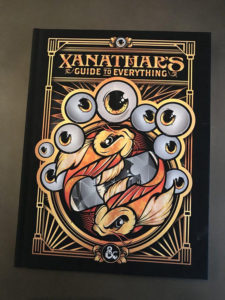
It’s a book called Xanathar’s Guide to Everything, a Dungeons and Dragons expansion.
It shouldn’t seem surprising at all that I bought a new D&D book. I teach with it, I have been a fan since I was about twelve years old.
Here’s the thing: I bought the edition pictured above for $45. It’s a collector’s edition with a pretty cover. The regular edition can be had for much less. And when I use it to play, I’ll be using a PDF version, since I only use my own books at home and I rarely, if ever, play at my house.
I did the same thing last year with this:

This is the twice-as-expensive Volo’s Guide to Monsters. I have it on my bookshelf. I also have a really cool wall art print of this cover from the launch event at Meltdown Comics framed on my wall. I ran a campaign with a mindflayer once way back in the day, and it’s a cool memory to see on the wall.
Moments where I make purchases like this give me pause. I’m a collector. I always have been, though I’ve usually had to collect things that were cheap. Poor people, after all, don’t get afforded the right to be collectors. Tell my Pop shelves that. 🙂
This is what I was thinking through, as I considered some of the collector’s items I own. I have a super-rare Scud action figure that I look at every single day (it’s hanging right behind the desk where I’m typing this). I am currently talking to someone about picking up a not-insanely-expensive-but-higher-than-retail Game of Thrones Funko Pop I’ve wanted for about a year.
On the surface, spending something like an extra $25 for a book just for a cover, or paying $40 for a $9 toy that has an actual value of probably 50 cents in plastic, doesn’t seem like a wise thing to do when you’re someone on a budget struggling to get the ship corrected. It’s like buying a drink from Starbucks; should a person really spend $5 on coffee?
When well off people buy things they collect, go out for an expensive meal, buy an expensive drink, it’s called “self care.” Self care, as defined by the Buffalo school of social work, is:
Self-care is an essential social work survival skill. Self-care refers to activities and practices that we can engage in on a regular basis to reduce stress and maintain and enhance our short- and longer-term health and well-being. Self-care is necessary for your effectiveness and success in honoring your professional and personal commitments.
It’s important to do what we can to lower our stress, particularly if we work– as most of the people I know and who might be reading this do– in the academy, a place where as teachers and mentors we basically live in a pressure cooker of presumed importance (the things people turn into “a thing” can really surprise you), where we have to teach and do service and try to publish, often taking on the stresses of our students and the people we advise. We work in a service industry where lots of people’s excess emotions and stresses stick to us.
So the belief is — at least from some– that self-care isn’t something that a person who is financially challenged should indulge in. But you know who needs it the most? People who are dealing with the stress of paying for their educations and surviving a weakened, uber-competitive job search, in a profession where there’s a way to become almost bulletproof but it requires walking a tightrope over a pit of flame.
So yeah, sometimes I buy a blind-pack vinyl toy at the Walgreens after work just because it makes me happy.
And sometimes I blow $20 on a comic book and put it in a frame on my wall.
I also haven’t blown up on anyone who didn’t deserve it, and I manage to survive in spite of the fact that I came out of grad school to a job making over 20K less a year than I was told to expect. I worked that job for five years before this one.
Love yourself. Don’t be an idiot, but if someone tells you “hey, should you really be going out to see a movie AND buying popcorn and drinks at the theater?” tell them to jog back about 30 feet, run full force at you, and bite your ass.
You’re worth it.