
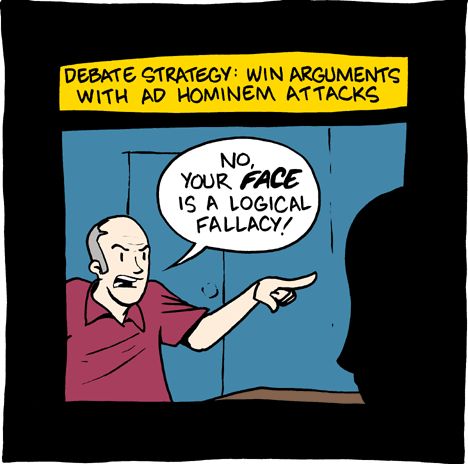
“But Christopher M. Johnson suggests, in his study of the ad hominem, that “given our intellectual limitations and the pressures we are faced with to make decisions in the absence of final or compelling evidence, it can sometimes be appropriate to appeal to character as a means of settling contention.” Though he would almost certainly disagree that Trump is using the tactic properly, it’s interesting to consider the implications of his work.”
-Garrett Stack, The Silver Tongue, read the full piece here. No express claims to sharing views or endorsement of or from the original author– just citing a person citing a study.
Not that it was ever out of style, the ol’ ad hominem attack is back and better than ever. Our President uses this tactic more than any other. “Little Marco.” Calling Elizabeth Warren “Pocahontas.” He’s quick to attack the character of things, presumably because he doesn’t have a solid argument against the person’s point.
But this one hits closer to home. As someone who teaches a class on Digital Identity, I spend a great deal of that course trying to teach careful rhetoric while asking people to consider situations that are controversial and uncomfortable. This can lead to moments where students get overly emotional, and I fully respect that and talk anyone who hits that point through it. I fully believe that this is the only way to teach critical thinking: we have to show students who hit the edge of their comfort zone how to take the next steps without being discourteous but also without losing their own convictions.
One of the topics that the class looks at is Gamergate. If you don’t know what Gamergate is… why are you reading my blog? But seriously, here’s a quick, but as with all pieces probably biased, description. To put it very simply (and not accurately because it’s simple): Gamergate is either about ethics in games journalism or about the treatment of women (depending on what angle you take), but came about as the result of Zoe Quinn releasing a game called Depression Quest then claims about the voracity of reviews of the game, some linked to claims of collusion and coercion. It ended up being a loud social media argument and caused numerous women to receive death threats and worse. It was a bad thing, no matter how one looks at it.
When I teach this in my games classes and we have time, we try to flesh out the circumstances and I let the students talk. In the shorter Digital Identity class, I have to pack Gamergate in with other material (it’s a 3 week long class that covers 15 weeks of material, so some things have to be a little shorter– I couldn’t give Gamergate two days of class). So I chose a single reading. I chose one that was deliberately biased, and to literally decide which side got to be represented in that bias, I just took the first Google hit for “what is Gamergate,” which happened to be this article from Gawker. We all know Gawker has a stake in the Gamergate argument, but they also have some ethics issues that resulted in them paying Hulk Hogan a lot of money, so they are not a neutral source. But no one is. That’s part of the point.
It probably seems like I’m far afield from ad hominem right now, other than that Gamergate is packed with ad hominem attacks (it might be liquid Gamergate solution, actually). What shocked me with this class was that someone– and I won’t detail the exchange because it was one of my students, obviously– reacted to this article with an ad hominem attack on me. This was puzzling because I didn’t share my opinion about Gamergate at all. I just said “read this article then reflect on how Gamergate impacted feminism in gaming.”
Here’s the part that saddened me. The student had some good, arguable points that could be defended with evidence amid what was basically a rant about how wrong I was. The student in this case could have written an effective counter to the Gawker piece, and that could have been a great intellectual exercise. Something instead led to attacking the professor.
Let me pause, just incase anyone read quickly and think I was being petty. I would have NO problem with the student disagreeing with me. I encourage that in my classes, actually, because I don’t want my students to think I expect them to take on my view. It’s just that I didn’t state an opinion. I deliberately didn’t, because I knew that if I did what I’m about to do in this post, I’d bias the class. I wanted it to be their discussion.
I’m not certain I’d have agreed with that student, but I’m not certain I agree with Gawker. The only thing I ever definitively say about Gamergate is that the abuse and threats suffered by people like Zoe Quinn and Anita Sarkeesian were totally and completely unacceptable.
Attacks like this: (warning– super graphic) [spoiler]
 [/spoiler]
Things like that can’t be justified. There’s never in the history of time been an argument where a rape threat was the right response. Also– that’s an ad hominem attack (in a twisted way, but it is, as it suggests that instead of considering the woman’s opinion, the woman in the argument is just an object to be used for sex, sex meant to subjugate her. It’s an AWFUL thing to say and a terrible argument).
I feel for this generation as it learns rhetoric, though. We were moving into an era where I don’t think people were as quick to go to the “well, you suck” argument. It’s the default again now, though. We already face a number of difficult issues that will need to be discussed and thought out in society. If we can’t move above insulting and threatening each other, the world is going to be one harsh place.