
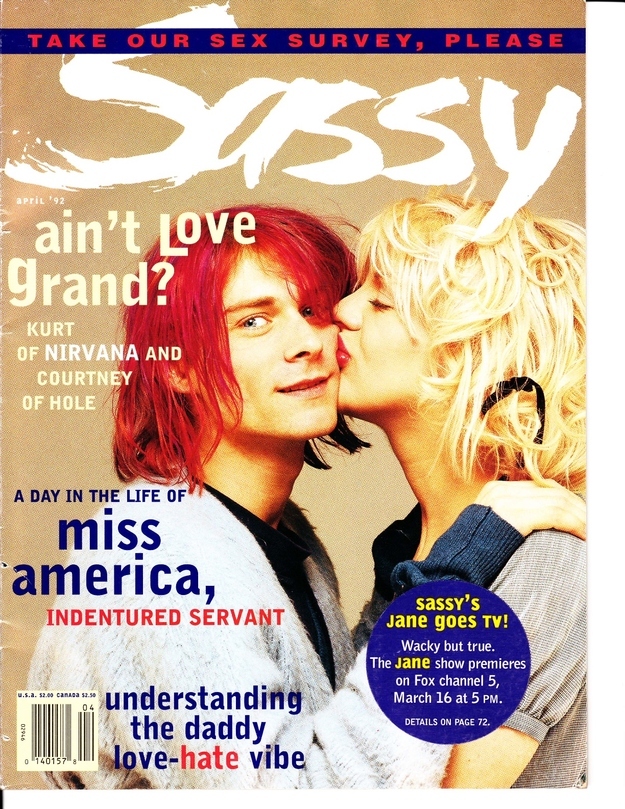
It sure sounds funny when you say his name like that.
-For Squirrels, “Mighty KC”
With the dawn of the Trump America, I’ve been even more nostalgic than usual. But as I revised my book manuscript this week, I found myself listening to the 90’s Alternative station on Slacker (and I’ve almost taught it to never play Oasis other than “Wonderwall,” Pavement, or Bush). I realized that when I listen to 90’s music, I write quicker, with more confidence.
I wondered if that was because I’m 40, and I’m not young anymore. I really, deeply and truly considered that. But that’s not what it is. What it is, honestly, is a little bit distressing.
But first, I want to tell you a story from my time in my MA program. I really enjoyed my MA, in spite of the fact that for some reason had to take a number of literature classes where instructors had distain for my desire to do cultural rhetorical work. But I had a moment in my research methods class that was particularly troubling for me.
We read an article about learning to write in the discipline. I forget the title, but I will dig it up sometime later and edit this post. I know the pseudonym of one of the co-authors/the subject of the study was Nate. The piece wasn’t super-controversial or anything, and the rest of the students in the class seemed to take it at face value.
I was furious with it, though. The whole article was about how graduate education essentially broke Nate (my interp– he was “learning the discipline”). It disturbed me that he was treated in such a way, as if he was something to break down and rebuild.
Fast forward several years, and in a contentious moment during one of my PhD yearly reviews, I am asked point blank “you said you didn’t learn much from this class. Why are you resisting it? Didn’t you come here to learn?”
I did, of course. I went there to learn (and I did learn– I learned so much). But I was also resisting. I thought it was just anger at the time, anger at how things were going in my life. I had a really bad year (not just school– in fact mostly because I was given a drug I was allergic to and almost died). I was angry.
Zack de la Rocha told me that my anger is a gift. I believe that. And in the tradition of the Wordcraft Circle, sometimes I return the gift.
But I realized this weekend, while I was in a hyper-contemplative moment of revision, plugging away at a completely new chapter I added to my book. The anger… at the article, at the idea that a classroom and its methods should change me in some specific way… that was about culture. It was about the western tradition attempting to erase my Cherokee storyteller’s voice, trying to discipline it into someone who writes in a litany of canned theory. It was trying to take something away from me.
In my senior project as an undergrad, which was an auto ethnography, I wrote about how I used to wish my internal voice, my writer’s voice, was pretty and high minded, melodic and elegant. But my voice isn’t that. It’s staccato. It’s Zack de la Rocha, snarling and swirling. Words move in my head quickly, they churn. Ideas stick and keep sticking. They require me to work them out. Sometimes I can’t sleep because that voice, rattling on in my head wants to write even when the body is asleep. Mind awake. Body asleep. Mind awake. Body asleep.
My discovery this week: 90’s music makes me a better writer because it reminds me of how I wrote before anyone tried to “discipline” me. And no, I don’t mean that I am ignoring my training, or that I knew better. I’m forever transformed and forever grateful for my graduate education. But my snarl is my snarl. Disconnecting me from my inner voice is like asking a flower to grow with no roots. I can’t be me without it.
As I wrote in one of my last academic papers, I know that I will die with my teeth clinched, my eyes wide open, scrutinizing and verbalizing.
And I do that better when I can remember the time when the gatekeepers and censors I’ve built over the years are lulled to sleep and the 40-year-old me can remember how the high school version of me filled notebook after notebook with thoughts.
I pains me that composition as a field thinks that the best idea of how to make the field better is to teach one tradition to everyone, as if every voice is the same. I just saw on my television the actions of a man who thinks everyone should think and see the world his way. He’s firing anyone who doesn’t agree. He’s dangerous.
But we’re all dangerous, too.
Your anger is a gift.
Don’t lose track of it trying to sound the way someone else wants you to sound.